What Is SigAlert? Complete Guide 2026 – Live Traffic, Maps & Alerts Explained
If you drive in California, you’ve almost certainly heard the term SigAlert on the radio, seen it on Google Maps, noticed it on electronic freeway signs, or received it through a navigation app. In 2026, with congestion reaching record levels across Los Angeles, San Diego, the Bay Area, Sacramento, Orange County, and other major regions, understanding how SigAlert works can help you save time, fuel, and unnecessary frustration.
Unlike an ordinary traffic report, a SigAlert is an official notification of a serious traffic disruption that requires immediate attention. Whether you’re commuting on the I-405, I-5, US-101, I-80, I-10, or another major California freeway, knowing how to interpret and respond to a SigAlert can make your trip much smoother. This complete 2026 guide explains everything you need to know, including its history, how it works, what causes it, where to check live updates, and expert tips for avoiding delays.
What Is a SigAlert? The Official Definition
A SigAlert is an official traffic advisory issued by the California Highway Patrol (CHP) for any unplanned event that causes the closing of one lane of traffic for 30 minutes or more. Although many CHP communication centers now commonly issue SigAlerts for incidents involving two or more blocked lanes and major traffic disruptions, the long-standing official CHP definition remains based on one lane closed for at least 30 minutes.
Unlike routine congestion, a SigAlert is reserved for incidents that create significant delays and require motorists to consider alternate routes. When a SigAlert is declared, information is immediately distributed through the CHP Traffic Incident Information Page, Caltrans, radio and television stations, electronic freeway message signs, and modern navigation platforms.
Common incidents that trigger a SigAlert include:
- Major multi-vehicle collisions
- Overturned trucks and jackknifed big rigs
- Hazardous material spills
- Police investigations and freeway pursuits
- Wildfires, flooding, and mudslides
- Bridge damage or infrastructure failures
- Fallen power lines or large roadway debris
Simply put, if traffic will remain blocked for an extended period, it is no longer just congestion—it becomes a SigAlert.
The History and Origin of SigAlert
The term SigAlert is unique to California and has a fascinating history dating back to 1955 in Los Angeles.
It was created by Loyd C. Sigmon, a radio engineer who designed a specialized radio receiver and tape-recording system that allowed the Los Angeles Police Department (LAPD) to instantly send urgent traffic bulletins to local radio stations. These emergency broadcasts were originally known as “Sigmon Traffic Alerts,” a phrase that was eventually shortened to SigAlert.
Before this innovation, police officers had to contact radio stations individually whenever a major incident occurred. Sigmon’s system dramatically improved emergency communication and transformed traffic reporting across Southern California. Traffic reporter Bill Keene even referred to Sigmon as the “father of L.A. traffic reporting.”
As freeway responsibilities shifted from the LAPD to the California Highway Patrol, CHP adopted the SigAlert system and modernized it with computerized dispatch and statewide communications. More than 70 years later, the name remains deeply embedded in California driving culture.
How Does SigAlert Work in 2026? Technology Behind the Alert
Today’s SigAlert system is far more advanced than the original radio-based network. It now operates as a fully integrated, data-driven transportation system designed to detect incidents quickly and distribute alerts in real time.
The process begins with incident detection. Reports may come from CHP patrol officers, 911 callers, Caltrans traffic cameras, road sensors, and increasingly from GPS-based traffic data collected through apps such as Google Maps, Apple Maps, and Waze. Sudden traffic slowdowns and crowdsourced reports often provide the earliest indication of a developing problem.
Next comes verification. CHP dispatchers evaluate the incident to determine whether it meets the criteria for a SigAlert. If officials determine that lanes will remain blocked for approximately 30 minutes or longer, the alert is officially declared.
Once confirmed, the information is immediately distributed across numerous platforms, including:
- CHP Traffic Incident Information Page (cad.chp.ca.gov)
- SigAlert.com Live Traffic Map
- Caltrans QuickMap
- Google Maps
- Apple Maps
- Waze
- Electronic freeway message signs
- Television and radio traffic broadcasts
The SigAlert remains active until CHP determines the roadway has reopened. Even after cancellation, traffic congestion may continue for hours while normal traffic flow recovers.
Types of Incidents That Trigger a SigAlert
Not every accident results in a SigAlert. CHP reserves these alerts for significant, unplanned events with substantial traffic impacts.
The most common causes include major traffic collisions, particularly crashes involving multiple vehicles, fatalities, overturned trucks, or lengthy investigations requiring lane closures.
Another major category includes hazardous material incidents, such as fuel spills, chemical leaks, cargo spills, or dangerous debris that creates unsafe driving conditions.
Law enforcement activity can also trigger a SigAlert. High-speed pursuits, freeway investigations, bomb threats, officer-involved incidents, and emergency searches sometimes require complete or partial freeway closures.
California’s weather and geography also play a role. Wildfires, mudslides, flooding, fallen trees, sinkholes, damaged bridges, and power line failures frequently generate SigAlerts during severe weather seasons.
It’s important to understand that planned construction projects generally do not qualify as SigAlerts. Scheduled lane closures announced in advance are typically classified as Traffic Advisories instead.
How to Check SigAlert Live Maps and Real-Time Traffic Updates
Checking traffic before leaving home has become one of the easiest ways to avoid lengthy delays.
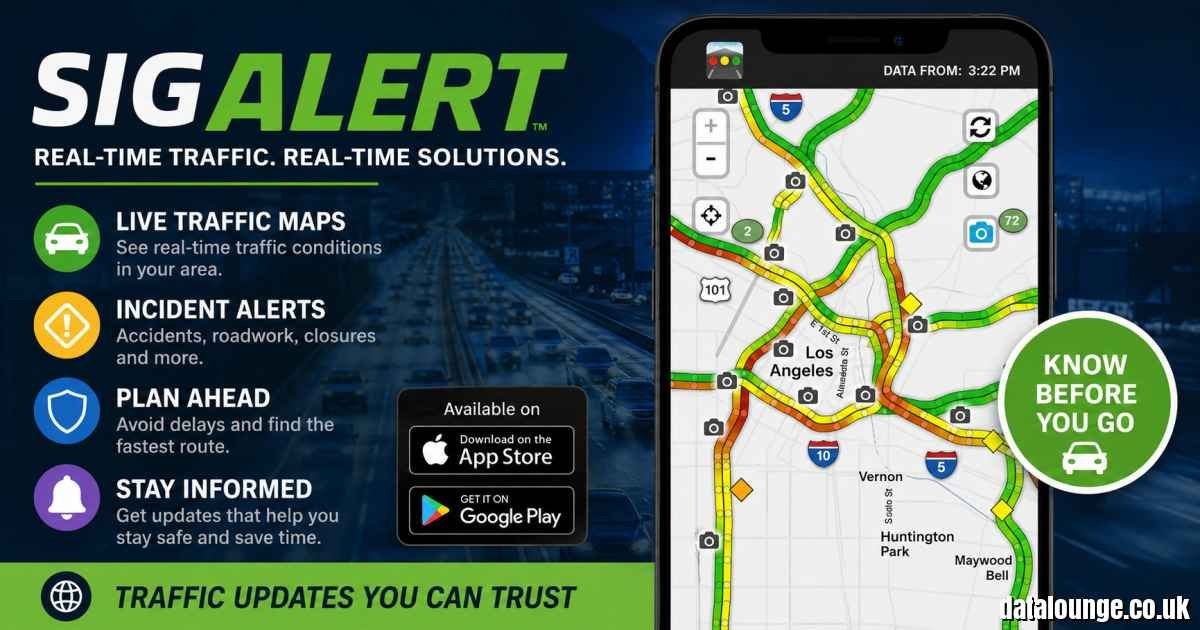
The most trusted resource is SigAlert.com, which offers a live traffic map displaying active SigAlerts, freeway speeds, congestion levels, traffic cameras, and detailed incident reports for major California cities including Los Angeles, San Diego, Orange County, Sacramento, and the San Francisco Bay Area.
Another excellent resource is Caltrans QuickMap, the California Department of Transportation’s official mapping platform. It combines SigAlerts with road closures, chain controls, weather information, and live CCTV camera feeds.
Drivers who prefer official incident reports can visit the CHP Traffic Incident Information Page (cad.chp.ca.gov), where dispatch logs provide real-time updates directly from CHP communications centers.
Navigation apps such as Google Maps, Apple Maps, and Waze also integrate CHP traffic information and automatically reroute drivers around serious incidents whenever possible.
Pro Tip for 2026: Enable traffic notifications for your daily commute. Receiving a SigAlert before leaving can easily save 30 to 120 minutes during peak congestion.
Why SigAlert Is So Important for California Drivers
California consistently ranks among the most congested regions in the United States. Drivers in metropolitan areas such as Los Angeles often spend well over 90 hours each year stuck in traffic, making reliable traffic information more valuable than ever.
A single SigAlert affecting the I-405, I-5, US-101, I-10, or I-80 during rush hour can impact thousands of commuters, freight deliveries, rideshare drivers, emergency responders, and local businesses.
By paying attention to SigAlerts, motorists can:
- Avoid major traffic delays
- Reduce fuel consumption
- Improve driving safety
- Plan alternate routes
- Minimize commute stress
- Protect delivery schedules
- Improve trip planning for long-distance travel
For commercial trucking companies, logistics providers, and rideshare drivers, SigAlerts are also essential operational tools that help reduce costly delays.
SigAlert vs. Regular Traffic Alerts
Many drivers mistakenly believe every traffic report is a SigAlert, but there are important differences.
| Feature | Regular Traffic Alert | SigAlert |
|---|---|---|
| Severity | Minor slowdown or congestion | Major traffic disruption |
| Duration | Usually under 30 minutes | Typically 30 minutes or longer |
| Lane Impact | Shoulder or minor lane issues | One or more major lane closures |
| Issued By | Navigation apps or media | California Highway Patrol (CHP) |
| Purpose | Inform drivers | Warn drivers to consider alternate routes |
If you hear the word SigAlert, it’s generally wise to reroute immediately rather than waiting for conditions to improve.
Pro Tips to Avoid SigAlert Traffic in 2026
Although nobody can prevent a SigAlert from occurring, experienced California drivers know how to minimize its impact.
Before every trip, spend a minute checking SigAlert.com, Caltrans QuickMap, or your preferred navigation app. Keeping Google Maps or Waze active during your drive allows automatic rerouting if conditions suddenly change.
Whenever possible, avoid the busiest commuting periods between 7:00–10:00 AM and 4:00–7:00 PM, when SigAlerts create the longest backups. Always identify at least one alternate route before beginning your trip, especially if your commute relies heavily on major freeways like the 405, 5, 101, or 10.
Keeping your phone charged, maintaining extra fuel for longer drives, and following official CHP instructions during emergencies can also make unexpected delays much easier to manage.
Final Verdict
In 2026, SigAlert remains California’s most important official traffic alert system. From its beginnings as a revolutionary radio broadcast created by Loyd C. Sigmon in 1955 to today’s AI-assisted network powered by CHP, Caltrans, GPS data, traffic cameras, and navigation apps, SigAlert continues to help millions of drivers travel more safely and efficiently.
Whether you’re commuting daily in Los Angeles, navigating the Bay Area, driving through Sacramento, or planning a road trip anywhere in California, understanding how SigAlert works can save valuable time and reduce stress. Bookmark SigAlert.com, monitor Caltrans QuickMap, enable navigation alerts, and make checking traffic part of your daily routine to stay one step ahead of major freeway disruptions.